
Strip Diagram: Equal Groups [TEKS Tools Grade 4]

Updated: Sep 28
This post specifically looks at how equal groups strip diagrams can be used to solve a variety of problems. Read more about TEKS Tools and their rationale here.
Strip Diagram
Strip diagrams, the first TEKS Tool, account for around 25% of each 4th grade STAAR test. Within this tool are many variations: part-whole, equal groups, and comparison (the first two being the primary types of strip diagram used).
The main function of a strip diagram is to show the relationship between the quantities in the problem situation. When the relationship is evident, students can select the correct operations and perform accurate calculations.
One thing to note about strip diagrams is that the total can be shown in a variety of ways and positions. I vary how I represent the total to match the various representations seen on STAAR.
Equal Groups
Equal groups are used to solve problems involving multiplication and division. There are several TEKS listed below that included these operations.
4.4D - use strategies and algorithms, including the standard algorithm, to multiply up to a four-digit number by a one-digit number and to multiply a two-digit number by a two-digit number. Strategies may include mental math, partial products, and the commutative, associative, and distributive properties
Click on each > to expand
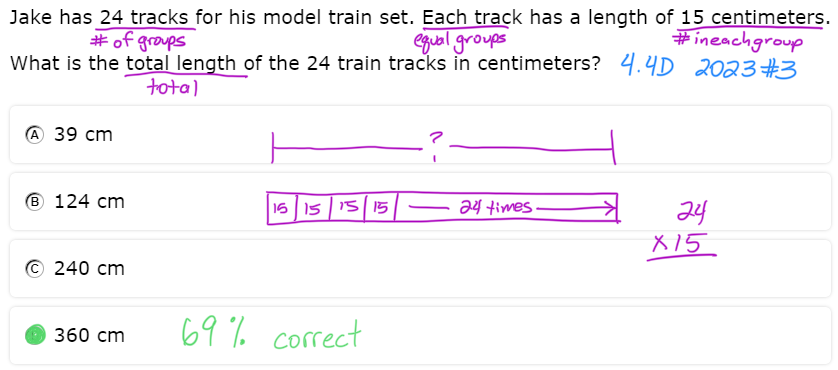
2023-3: the number in each group and the number of groups were given, students had to solve for the total
2025-31: the number in each group and the number of groups were given, students had to solve for the total

4.4D Practice Set
4.4E - represent the quotient of up to a four-digit whole number divided by a one-digit whole number using arrays, area models, or equations
Click on each > to expand
2023-12: the number of groups and the total were given, students had to solve for the number in each group

2024-25: the number in each group and the number of groups were given, students had to solve for the total

2025-29: the number of groups and the total were given, students had to solve for the number in each group

4.4E Practice Set
4.4F - use strategies and algorithms, including the standard algorithm, to divide up to a four-digit dividend by a one-digit divisor
Click on each > to expand
2023-22: the number of groups and the total were given, students had to solve for the number in each group

2024-27: the number of groups and the total were given, students had to solve for the number in each group

4.4F Practice Set
4.4H - solve with fluency one- and two-step problems involving multiplication and division, including interpreting remainders
Click on each > to expand
2023-27: the number of groups and the number in each group were given, students had to solve for the missing total and then divide that total into equal groups while interpreting the remainder

2024-4: the number in each group and the total were given, students had to solve for the number of groups and then divide that total into equal groups while interpreting the remainder

2025-7: the number of groups and the number in each group were given, students had to solve for the missing total and then divide that total into equal groups while interpreting the remainder

2026-29: the total and the number in each group were given, students had to find the number of groups and interpret the remainder

4.4H Practice Set
4.8C - solve problems that deal with measurements of length, intervals of time, liquid volumes, mass, and money using addition, subtraction, multiplication, or division as appropriate
Click on each > to expand
2026-1: the number of groups and the number in each group were given, students had to solve for the total

2026-26: the number of groups and the number in each group were given, students had to solve for the total

4.8C Practice Set
![Number Line: Solving problems [TEKS Tools Grade 4]](https://static.wixstatic.com/media/7cf6a4_b5851beff52a4e3f9f69e899a295a9ba~mv2.png/v1/fill/w_980,h_551,al_c,q_90,usm_0.66_1.00_0.01,enc_avif,quality_auto/7cf6a4_b5851beff52a4e3f9f69e899a295a9ba~mv2.png)
Comments