
Strip Diagram: Equal Groups [TEKS Tools Grade 3]

Updated: Aug 24
This post specifically looks at how equal groups strip diagrams can be used to solve a variety of problems. Read more about TEKS Tools and their rationale here.
Strip Diagram
Strip diagrams, the first TEKS Tool, account for around 39% of each 3rd grade STAAR test. Within this tool are many variations: part-whole, equal groups, and comparison (the first two being the primary types of strip diagram used).
The main function of a strip diagram is to show the relationship between the quantities in the problem situation. When the relationship is evident, students can select the correct operations and perform accurate calculations.
One thing to note about strip diagrams is that the total can be shown in a variety of ways and positions. I vary how I represent the total to match the various representations seen on STAAR.
Equal Groups
Equal groups are used to solve problems involving multiplication and division. There are several TEKS listed below that included these operations.
3.4D - determine the total number of objects when equally-sized groups of objects are combined or arranged in arrays up to 10 by 10
Click on each > to expand
2024-11: the number in each group and the number of groups were given, students had to solve for the total

3.4D Practice Set
3.4F - recall facts to multiply up to 10 by 10 with automaticity and recall the corresponding division facts
Click on each > to expand
2026-29: the total and the number in each group were given, students had to find the number of groups

3.4F Practice Set
3.4G - use strategies and algorithms, including the standard algorithm, to multiply a two-digit number by a one-digit number. Strategies may include mental math, partial products, and the commutative, associative, and distributive properties
Click on each > to expand
2024-28: the number in each group and the number of groups were given, students had to solve for the total

2026-5: the number in each group and the number of groups were given, students had to solve for the total

3.4G Practice Set
3.4H - determine the number of objects in each group when a set of objects is partitioned into equal shares or a set of objects is shared equally
Click on each > to expand
2023-2: the total and the number in each group were given, students had to solve for the number of groups

2025-25: the total and the number of groups were given, students had to solve for the number in each group

2026-24: the total was given, students had to find two combinations of number of groups and the number in each group

3.4H Practice Set
3.4J - determine a quotient using the relationship between multiplication and division
Click on each > to expand
2023-27: the total and the number in each group were given, students had to find the number of groups

2025-2: the total and the number of groups were given, students had to solve for the number in each group

3.4J Practice Set
3.4K - solve one-step and two-step problems involving multiplication and division within 100 using strategies based on objects; pictorial models, including arrays, area models, and equal groups; properties of operations; or recall of facts
This standard includes both one-step and two-step problems, both of which can be represented with equal groups strip diagrams.
Click on each > to expand
2023-15: the number of groups and the number in each group were given, students had to find the subtotal from a portion of the groups

2024-20: the total and the number in each group were given, students had to find the number of groups
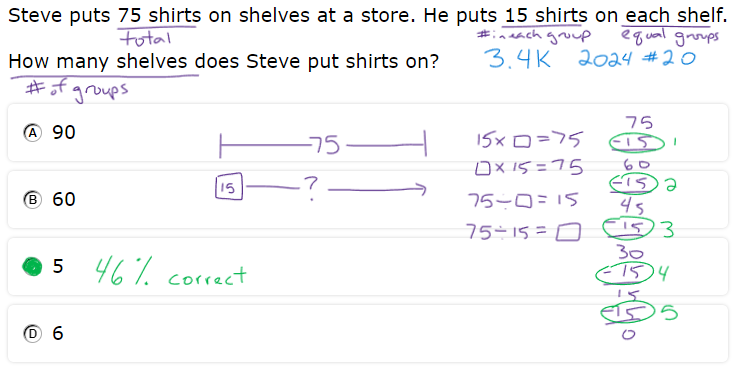
2025-10: the total and the number of groups were given, students had to find the initial amount in one group and then divide that portion into smaller groups

2025-21: the total and the number in each group were given, students had to find the number of groups

2026-26: the total and the number in each group were given, students had to find the initial amount number of groups and then divide that portion to find the final number in each group

3.4K Practice Set
3.5B - represent and solve one- and two-step multiplication and division problems within 100 using arrays, strip diagrams, and equations
This standard includes both one-step and two-step problems, both of which can be represented with equal groups strip diagrams.
Click on each > to expand
2023-4: the total and the number of groups were given, students had to solve for the number in each group

2023-29: the number of groups and number in each group were given, students had to solve for the total

2024-15: the number of groups and number in each group (twice) were given, students had to solve for the total

2024-26: the total and the number of groups were given, students had to find the subtotal of part of the groups

2025-8: the total and number of groups were given (twice), students had to find the number in each smaller group

2026-8: the number of groups and the number in each group were given (twice), students had to find the total

3.5B Practice Set
3.6C - determine the area of rectangles with whole number side lengths in problems using multiplication related to the number of rows times the number of unit squares in each row
Before the formal introduction of a formula, an equal group strip diagram can be used to solve problems involving area.
Click on each > to expand
2023-14: the number of groups and the number in each group were given, students had to solve for the totals

2024-21: the number of groups and the number in each group were given, students had to solve for the total

2025-20: the number of groups and the number in each group were given, students had to solve for the total

2026-27: the number of groups and the number in each group were given, students had to solve for the total

3.6C Practice Set
![Number Line: Solving problems [TEKS Tools Grade 4]](https://static.wixstatic.com/media/7cf6a4_b5851beff52a4e3f9f69e899a295a9ba~mv2.png/v1/fill/w_980,h_551,al_c,q_90,usm_0.66_1.00_0.01,enc_avif,quality_auto/7cf6a4_b5851beff52a4e3f9f69e899a295a9ba~mv2.png)
Comments