
Lessons learned from the 2026 4th Grade Math STAAR

Using a modified version of the statewide item analysis report, I examined the readiness standards that had less than 60% mastery. Each standard has both an analysis of the items themselves to infer what made them so difficult and instructional implications for educators to ensure a more successful 2027 STAAR test.
Standard | # of items | % mastery |
4.7C | 1 | 33 |
4.8C | 2 | 44.5 |
4.5D | 2 | 45 |
4.4A | 1 | 48 |
4.6D | 1 | 50 |
4.4H | 2 | 51 |
4.5B | 2 | 51.5 |
4.3E | 1 | 53 |
4.5A | 2 | 57 |
4.2G | 2 | 57.5 |
4.7C - 33% overall mastery
determine the approximate measures of angles in degrees to the nearest whole number using a protractor
#16 - 33% correct

Analysis
For the first time, this standard asked for the angle and the equation (written)
Two possible correct answers
The three blanks are still only worth one point altogether
Instructional Implications
When determining angles, have students justify reasoning verbally, in writing, and with an equation
Ask students to solve it both ways (inside and outside numbers)
Combine with 4.7D and only provide one ray and the desired angle measure
4.8C - 44.5% overall mastery
solve problems that deal with measurements of length, intervals of time, liquid volumes, mass, and money using addition, subtraction, multiplication, or division as appropriate
#1 - 58% correct

#26 - 31% correct

Analysis
Instructional Implications
If a problem seems too easy, then there’s probably a hidden trick
Stress that these are reading problems first, math problems second
Drawing a representation (e.g., strip diagram) the multiple groups in each problem
Watch the full walkthrough of all 32 items on the 2026 4th Grade STAAR below.
4.5D - 45% overall mastery
solve problems related to perimeter and area of rectangles where dimensions are whole numbers
#3 - 68% correct

#30 - 22% correct

Analysis
Students didn’t struggle with #3 (one step - area)
For #30, students had to
1) Find the missing side length given perimeter and width
2) Calculate the area with the given width and the missing side length
3) Calculate the area of the other rectangles to find one that matches
For #30, 40% of students chose A (has the same perimeter, not area)
Instructional Implications
Area and perimeter should not be taught in isolation but together, using one to find the other
Practice with generative questions (e.g., A room has a perimeter of 32 feet and a width of 6 feet. Draw and label 3 different rectangles with the same area.)
4.4A - 48% overall mastery
add and subtract whole numbers and decimals to the hundredths place using the standard algorithm
#25 - 48% correct

Analysis
36% of students chose D (4.25 + 6.8)
This is the first time since redesign practice (2022) that equal groups (e.g., two pieces…each) have been used as addends
This standard is always tested as a word problem, not straight computation
Instructional Implications
Drawing a representation (e.g., strip diagram) would have shown the three parts that make the whole
This standard is about correctly interpreting a problem situation and applying operations, not just lining up the decimals
6.6D - 50% overall mastery
classify two-dimensional figures based on the presence or absence of parallel or perpendicular lines or the presence or absence of angles of a specified size
#14 - 34% full credit; 31% partial credit; 35% no credit

Analysis
The kite was rotated to make the right angle more prominent
In 2025 and 2026, this standard asked for classification of both parallel and perpendicular lines within the same set of shapes
Definitions for parallel and perpendicular lines are not provided
The table structure assumes students know to apply to categories to each shape
Instructional Implications
Ensure students know the relationship between right angles and perpendicular lines
Classify polygons with two categories minimum (e.g., parallel lines, perpendicular lines, right angles) using a table or Venn diagram
4.4H - 51% overall mastery
solve with fluency one- and two-step problems involving multiplication and division, including interpreting remainders
#12 - 62% correct

#29 - 40% correct

Analysis
Instructional Implications
Train students that when dividing anything in 4th grade, if a remainder exists, go back to the problem and label exactly what should happen to it
Use strip diagrams to model the relationship between quantities
4.5B - 51.5% overall mastery
represent problems using an input-output table and numerical expressions to generate a number pattern that follows a given rule representing the relationship of the values in the resulting sequence and their position in the sequence
#18 - 44% correct

#27 - 59% correct

Analysis
Instructional Implications
Evaluate if the expression equals the value (that in itself would have solved #18)
When rule is given, that has to be part of the expression (e.g., -5)
The expression should be the position + the rule equals the value
4.3E - 53% overall mastery
represent and solve addition and subtraction of fractions with equal denominators using objects and pictorial models that build to the number line and properties of operations
#15 - 52% correct

Analysis
Students had to identify the denominator as the total number of animals
Students had to identify the numerators as the number of dogs or cats
Instructional Implications
This standard has always been tested with a model and usually requires an expression rather than the sum or difference
When practicing with students, have them generate both the expression and the sum or difference
Always include a model
4.5A - 57% overall mastery
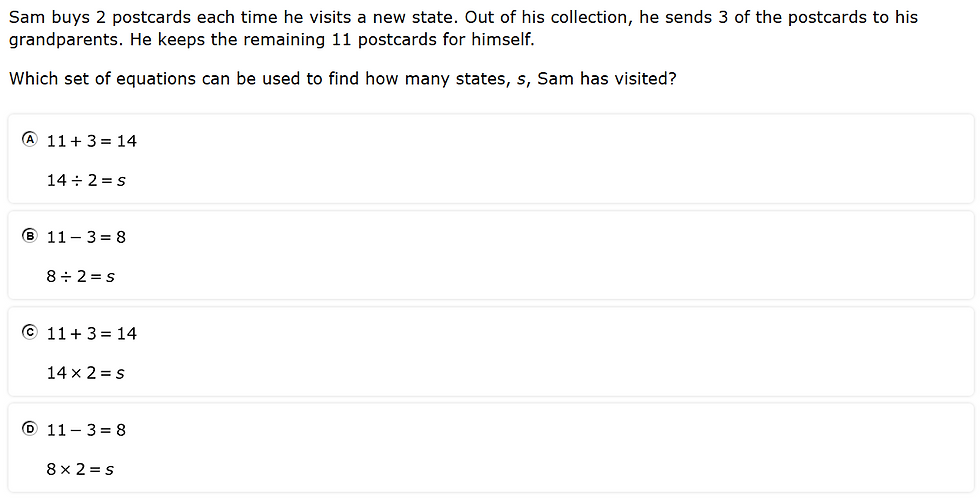
represent multi-step problems involving the four operations with whole numbers using strip diagrams and equations with a letter standing for the unknown quantity
#10 - 48% full credit; 39% partial credit; 12% no credit

#23 - 46% correct
Analysis
For #10, full credit required both a strip diagram and a set of equations
Order of operations is not introduced until 5th grade, so the equations should be separate
Both problems required multiple steps and a total in multiple parts
The unknown quantity can be the total (#10) or a part (#23)
Instructional Implications
Draw a strip diagram to represent each situation
Know that a two-step problem requires two equations
4.2G - 57.5% overall mastery
relate decimals to fractions that name tenths and hundredths
#7 - 70% correct

#19 - 45% correct

Analysis
Instructional Implications
Spend minimal time with proper fractions (e.g., 4/10 = 0.4)
Focus on multiple place value shifts, such as
1.74 → hundredths
2189/100 → decimal
![Number Line: Solving problems [TEKS Tools Grade 4]](https://static.wixstatic.com/media/7cf6a4_b5851beff52a4e3f9f69e899a295a9ba~mv2.png/v1/fill/w_980,h_551,al_c,q_90,usm_0.66_1.00_0.01,enc_avif,quality_auto/7cf6a4_b5851beff52a4e3f9f69e899a295a9ba~mv2.png)

Comments