
Algebraic Reasoning: Transformations [TEKS Tools Grade 8]

This post specifically looks at how algebraic reasoning can be used to solve problems related to rigid transformations and dilations. Read more about TEKS Tools and their rationale here.
Algebraic Reasoning
Algebraic reasoning accounts for around 27% of each 8th grade STAAR test. This thinking does not use a visible tool but instead relies on applying algebraic concepts to expressions, equations, and inequalities.
The main function of algebraic reasoning is to identify algebraic relationships in problem situations, perform rigid transformations and dilations, identify similar figures, and solve equations and inequalities.
Rigid Transformations
Algebraic reasoning can be used to understand translations, reflections, and rotations.
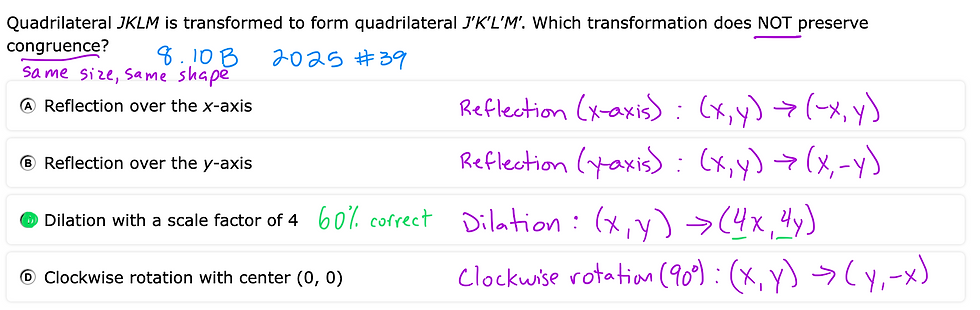
8.10B - differentiate between transformations that preserve congruence and those that do not
2025-39: four situations were given, students had to find the one that did not preserve congruence
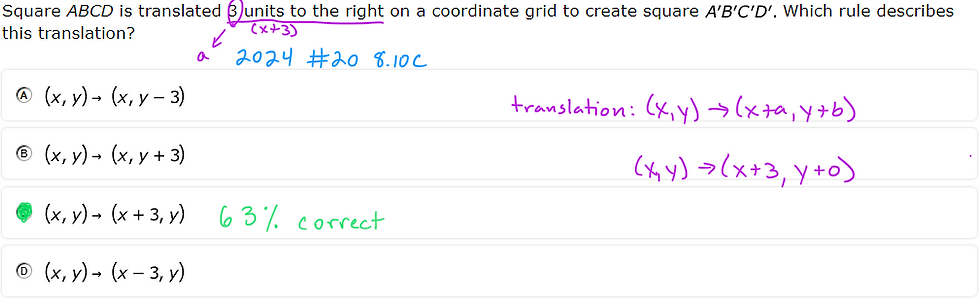
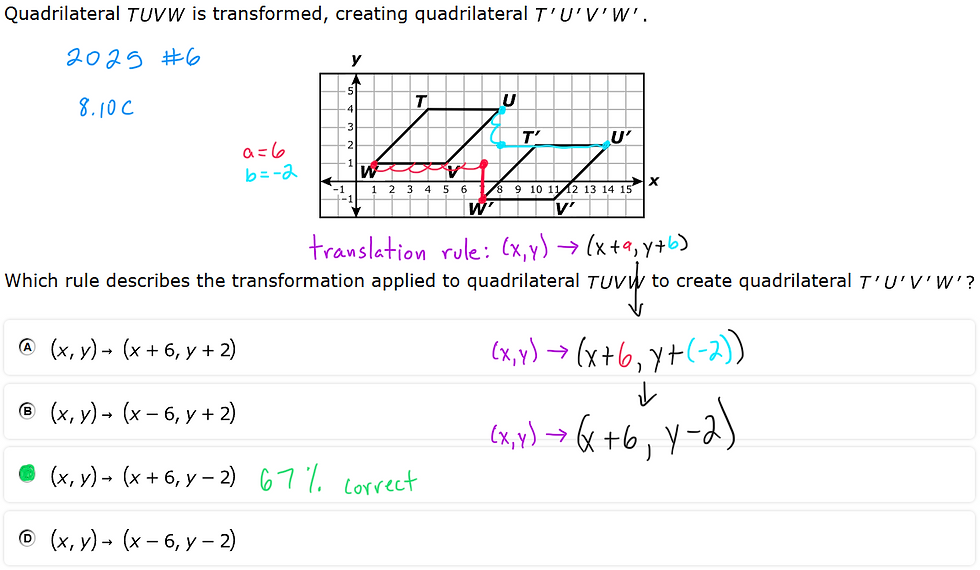
8.10C - explain the effect of translations, reflections over the x- or y- axis, and rotations limited to 90°, 180°, 270°, and 360° as applied to two-dimensional shapes on a coordinate plane using an algebraic representation
2023-8: a translation was given, students had to write the rule

2023-21: a figure was graphed, students had to find the algebraic rule that would not keep the same vertices

2024-20: a translation was given, students had to identify the rule
2025-6: a transformation was graphed, students had to identify the rule
Dilations
Algebraic reasoning can also be used to understand dilations.
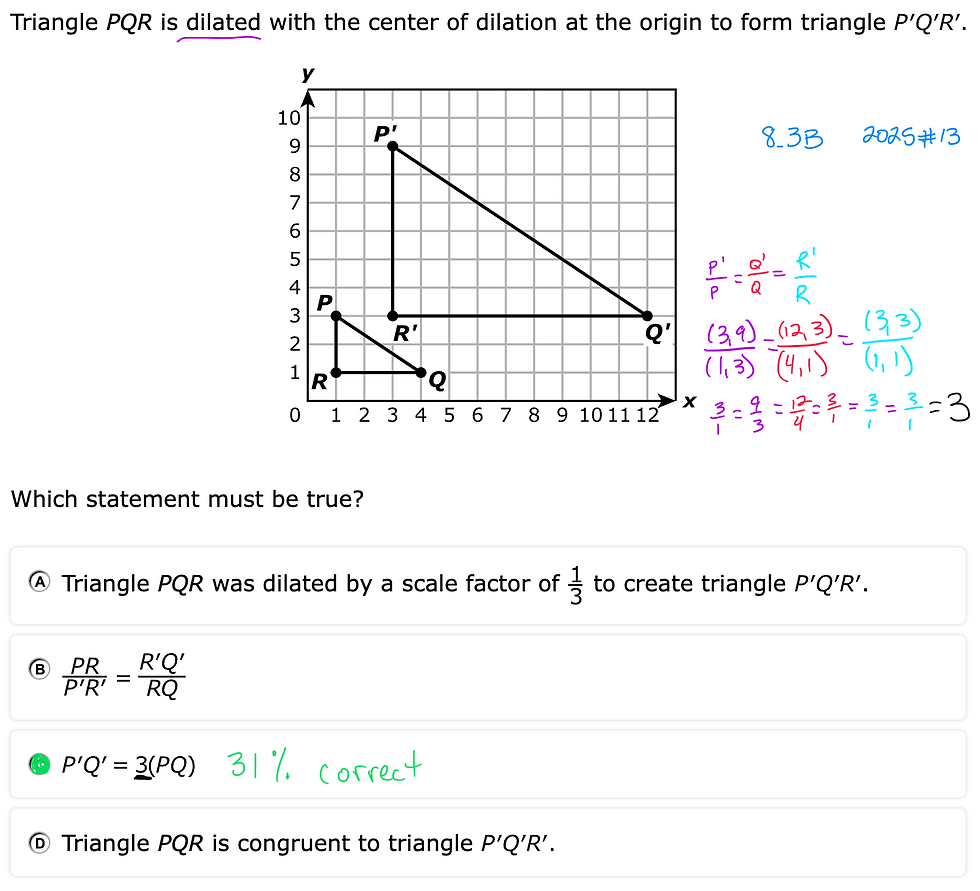
8.3B - compare and contrast the attributes of a shape and its dilation(s) on a coordinate plane
2023-11: a shape was graphed and a dilation rule given, students had to identify the correct description of the dilated shape

2025-13: a shape was graphed, students had to identify the correct description of the dilation
8.3C - use an algebraic representation to explain the effect of a given positive rational scale factor applied to two-dimensional figures on a coordinate plane with the origin as the center of dilation
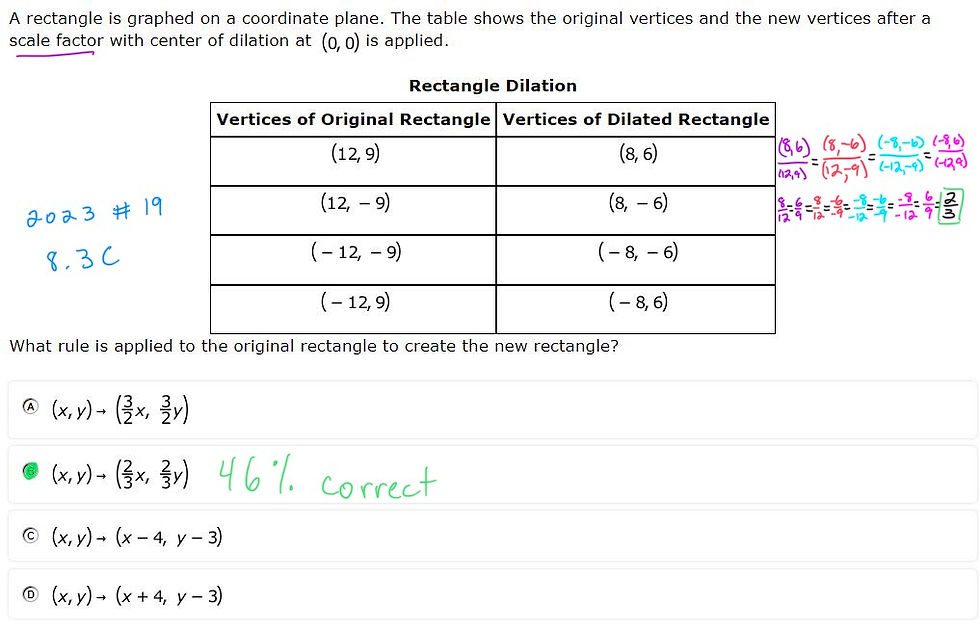
2023-19: vertices of a shape and its dilation were given, students had to identify the correct algebraic rule
2023-33: two dilation descriptions were given, students had to find the matching algebraic rules

2024-10: a shape and its dilation were graphed, students had to write the algebraic rule
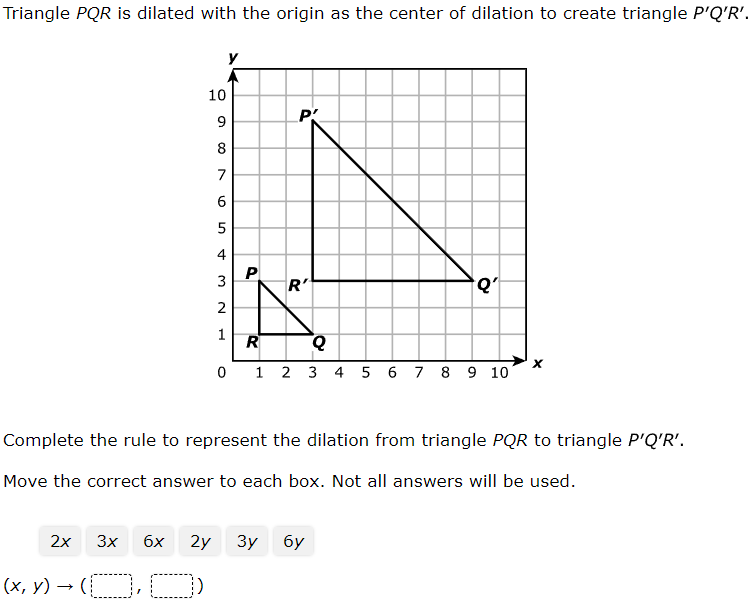
2024-28: a shape was graphed and a vertex of the dilated shape was given, students had to identify the algebraic rule

2025-17: vertices of a shape and its dilation were given, students had to identify the correct algebraic rule

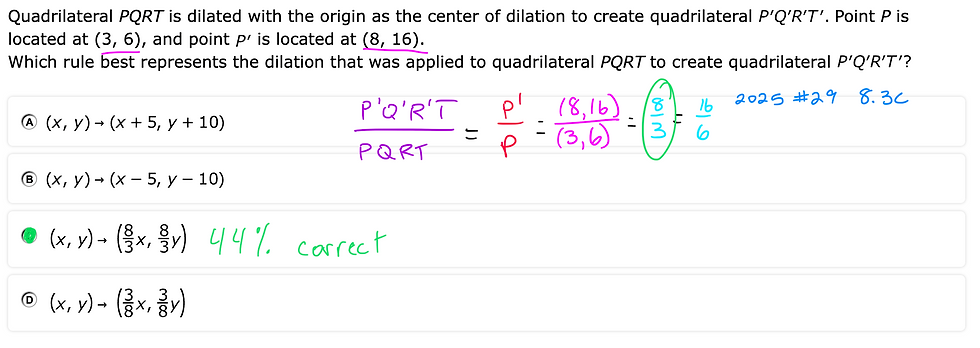
2025-29: a vertex and it's dilation are given, students had to identify the algebraic rule
8.10D - model the effect on linear and area measurements of dilated two-dimensional shapes
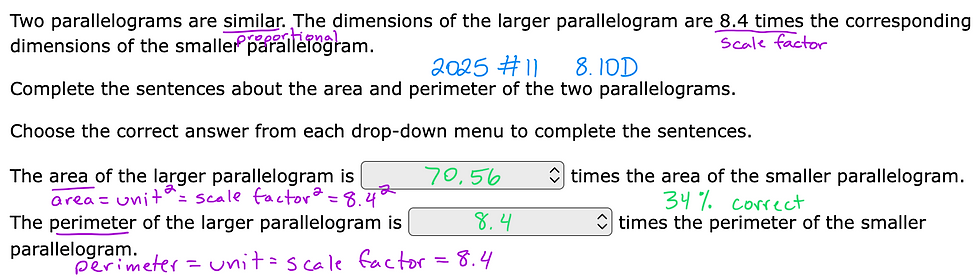
2025-11: descriptions of a dilation were given, students had to identify how the dilation affected the area and perimeter of the dilated shape
![Number Line: Solving problems [TEKS Tools Grade 4]](https://static.wixstatic.com/media/7cf6a4_b5851beff52a4e3f9f69e899a295a9ba~mv2.png/v1/fill/w_980,h_551,al_c,q_90,usm_0.66_1.00_0.01,enc_avif,quality_auto/7cf6a4_b5851beff52a4e3f9f69e899a295a9ba~mv2.png)
Comments